
Tarot Prior to the Golden Dawn: Classic and Early Esoteric Decks
This page is part of a larger tarot site. Click here to start at the top.

- Michael's Tarot Notebook (Michael J. Hurst) (via Wayback)
- The Classification of Tarot Designs (via Wayback)
- Histories of the Trump Cards (via Wayback)
- Robert O'Neill Library at Tarot.Com
- Sources of the Waite-Smith Tarot Symbols - Robert O'Neill, Edited by Nina Lee Braden (via Wayback)
- Tarot of the Bohemians by Papus
Italian Tarot in the 15th Century
Tarot Through the Ages: A discussion on early Italian Tarot, with Marco Benedetti and Sherryl Smith
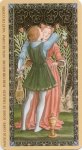
Charles VI or Gringonneur Tarot. Reproductions by Lo Scarabeo as "Estensi Tarot: Golden Tarot of the Renaissance". 2004. This late 15th century deck was made in Ferrara for the Estes family. This deck was mistakenly attributed to the painter Jacquemin Gringonneur hired by Charles VI in 1392 by Constant Leber in the nineteenth century. Only 17 cards of this deck are extant - the trumps (Fool, [Juggler], Emperor, Pope, Lovers, [Chariot], Justice, Hermit, Strength, Hanged Man, Death, Temperance, Tower, Moon, Sun, Angel, World, - The Star, Devil, Wheel, Empress, and Papess are missing.) and the Knave of Swords. The Lo Scarabeo version created new cards for the remainder of the deck. Giordano Berti researched and designed these with Majors inspired by other period decks such as Ercole I d'Este Tarot and Leber Tarot, and Minor arcana inspired by the frescoes in Palazzo Schifanoia and designed to comply with modern cartomantic interpretations, and the modern demand that pips be illustrated beyond a geometric arrangement of suit symbols. Jo Dworkin was the artist.

- Tarot-L History Information Sheet addressing the myth that these were invented in 1392
- The Gringonneur Case at Trionfi.Com
- The Early Ordering of the Trumps Tom Tadfor Little discusses this deck (via Wayback)
- Aeclectic Tarot - 4 1/2 stars
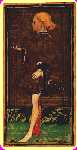
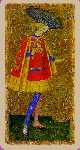
Visconti Tarocchi Deck. attributed to Bonifacio Bembo (Milan) and artists of the Ferrara school. Possibly completed 1428 (may have been done as a wedding present for Filippo Visconti and Maria Savoy) reproductions by US Games Systems, Lo Scarabeo, Dal Negro


- A Picture Is Worth 1000 Words - SCA Period
- Tom Tadfor Little Meet My Tarot Decks (via Wayback)
- Visconti Modrone (Cary-Yale)
- Mark Filipas' Review of Atanas Alexandrov Atanassov's I Torocchi dei Visconti
- David Roell's Review of Pierpont Morgan
- David Roell's Review of Cary-Yale
- Aeclectic Tarot - Visconti-Sforza (US Games) - 4 stars
- Aeclectic Tarot - Cary Yale Visconti (US Games) - 4 stars
- Aeclectic Tarot - Atanassov (Lo Scarabeo) - 5 stars
- Joan Bunning on Visconti Tarots by Atanas Alexandrov Atanassov
- Joan Bunning on the Visconti-Sforza Pierpont Morgan Tarocchi Deck
- Andy's Playing Cards - THE VISCONTI TAROTS (via Wayback)
- Images of entire Cary-Yale Visconti deck at Tarot.com
- Images of entire Visconti-Sforza deck at Tarot.com
Tarocchi del Mantegna. attributed to Andrea Mantegna (1432-1506). 1470. Reproductions by Lo Scarabeo and Meneghello.
- Adam McLean. An Hermetic Origin of the Tarot Cards? A Consideration of the Tarocchi of Mantegna (via Wayback)
- Rafal T. Prinke. Mantegna's Prints in Tarot History (via Wayback)
- Tom Tadfor Little Meet My Tarot Decks
- Mark Filipas's Review
- David Roell's Review
Sola Busca (Illuminating Ancient Tarots). Reproduction 1995 Lo Scarabeo S.r.l.. - perhaps the earliest known deck to have illustrated Minors [as opposed to pip cards] was the Sola Busca Tarot dated somewhere around the late 15th Century; the reproduction is of a copy c. 1900.
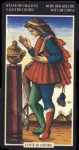

Sofia Di Vincenzo. Sola Busca Tarot. 1998: US Games. ISBN 1572811307
- Detailed information about the deck in this article by Michael Hurst (via Wayback)
- David Roell's Review
- Aeclectic Tarot - 4 stars
- Joan Bunning
- Get a reading with the deck at Facade.com
Tarot de Marseille in the 18th Century
Tarot de Marseilles. "These designs carry the name of Marseilles because that city was a principal card manufacturing center in the 17th and 18th centuries. The actual place of origin of the designs is unknown. When France conquered Milan in 1499, French and Swiss soldiers probably encountered Milanese tarot cards similar to those seen on the fragmentary sheet housed in the Cary collection of playing cards. This is probably how the game of tarot, and with it the Milanese card designs, spread to Switzerland and eastern France. At some point in the 16th century, the set of designs known as the Tarot de Marseille became the standard pattern for players in these French-speaking regions." (so saith Tom Tadfor Little)
There are a number of different Marseilles type designs, though compared with the variations in 20th century decks, the variations in these are far smaller.
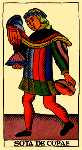


- The Marseilles Family (Tom Tadfor Little) (via Wayback)
- The Journey of the Soul: The traditional meaning of the 22 major arcana by JC Flornoy - contains reconstructions of images from Jean Noblet (Paris c.1650), Jean Dodal (Lyon c. 1701) and Nicolas Conver (Marseille c. 1760) decks for each of the 22 Trumps
- Comparison of Jean Dodal original to Flornoy reconstruction 22 trump images [Les images du Tarot de Jean Dodal - originaux conservés à la BN (1701/1715) + restauration]
- Jean Noblet images [Les images du Tarot de Jean Noblet]
- Camoin/Jodorowsky TdM a modern revisioning based on a number of Marseilles variants, including Chosson and Conver. "We tried to re-create the Tarot of Marseilles as it was originally. The original deck is now extinct. Its re-creation was a complex process of comparing all the symbols existing in the various European decks. This work was done in the Tarot of Marseilles' Tradition by its heir, with an extremely precise esoteric logic."
- THE TAROT OF MARSEILLES RESTORED OR "THE ART OF TAROT" by Alexandre JODOROWSKY
- Exploring the Alphabetic Tarot
- Review of Conver ("Ancient Tarots of Marseilles") by Tom Tadfor Little
- David Roell's Review
- Aeclectic Tarot
- Joan Bunning
- Images of entire deck at Tarot.com
Beautiful 19th Century Decks not in the Esoteric Tradition
Ancient Tarot of Lombardy. Ferdinando Gumppemberg, Milan. 1810. My version by Lo Scarabeo published 2000 is OOP. From the LWB "The production of the Tarots in Lombardy can be divided into two principal historic periods.
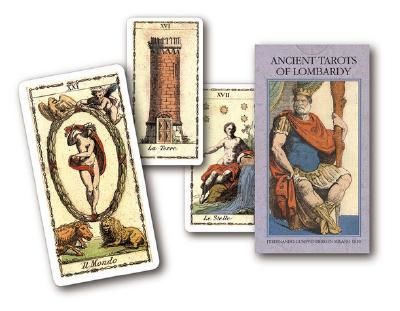
"In the 1400's, splendid illuminated decks were created including the Visconti di Modrone deck, the Brambilla deck and the Visconti Sforza deck. Unfortunately, "working-class" decks did not survive over time. The production of Tarots was quashed in the 1600s due to the repressive economic policy by the Spanish Regime. Only when Milan went under Austrian domination at the start of the second half of the eighteenth century did a rebirth of native production take place. In the meantime, the Tarots of Marseilles, which presented an iconography extremely similar to that of the traditional Lombard ones, developed and became widespread. (Historians unanimously attribute Lombard origin to the Tarots of Marseilles.) Therefore, card manufacturers at that time needed to try and compete with these.
"During Napoleon's conquest, the "Regia Fabbrica", property of the State, was created and was entrusted to management by Ferdinando Gumppenberg. Some of the most beautiful and innovative decks belong to this production. The splendid Neo-classical Tarot for example (approx. 1810), moved away from the Marseilles model with profound originality. The "Della Rocca" and "Della Corona Ferrea" decks were also a part of Gumppenberg production. The Tarots of Marseilles on the one hand and the growth of the esoteric component on the other, nevertheless, marked the second decline in Lombard production."
- The Ancient Tarots of Lombardy: Meet the Families! by Alison Cross
- Aeclectic Tarot - 4 stars
- Joan Bunning
Ancient Italian Tarot. Reproduction 2000 Lo Scarabeo S.r.l.. - Cartiera Italiana in Serravalle Sesia 1880. This is a late nineteenth century reproduction of an early nineteenth century Italian engraved deck by Carlo Dellarocca published by Gumppenberg and often known as the "Soprafino" (extra fine) deck (circa 1835). The Classic Tarot from Lo Scarabeo is based on the original 1835 Dellarocca deck.
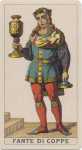

- The Ancient Italian Tarot by Kate Harris
- Soprafino: Nineteenth-Century Tarot in Milan by Sherryl E. Smith
- Lombardy Tarot and Tarocchino Milanese
- Andy's Playing Cards - The Tarot of Milan
- Aeclectic Tarot - 3 stars
- David Roell's Review
- Joan Bunning
French Occult Tarot
Esoteric Ancient Tarot. Etteilla. 1790.

- A History of Egyptian Tarot Decks by Mark Filipas
- The Influence of Etteilla & His School on Mathers & Waite, by James W. Revak.
- A Wicked Pack of Cards: The Origins of the Occult Tarot by Ronald Decker, Michael Dummett, Thierry Depaulis
- What Egyptian Tarots! by Giordano Berti (via Wayback)
- The Etteilla Tarot: When Tarot Got Esoteric by Tarot with Gord
- Benebell Wen Etteilla Tarot posts
- Lo Scarabeo The Book of Thoth - Etteilla Tarot
- Tarot Etteilla (limited edition Anima Antiqua deck)
Oswald Wirth. Oswald Wirth. 1889. This deck is recommended by Papus in the Tarot of the Bohemians. Wirth illustrated the 22 Trumps with the help of Stanislas de Guaita. Wirth did not create any versions of the Minor Arcana. I show the page of cups thumbnail here, because I show the page of cups for all the decks on these pages. This particular page of cups illustration is done by the illustrator Stuart Kaplan hired when producing his 78-card version of the Wirth deck.
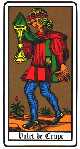


Wirth, Oswald. Tarot of the Magicians. Joseph Paul Oswald Wirth (1860-1943) First published in Paris in 1927 as Le Tarot, des Imagiers du Moyen Age English translation 1985: Samuel Weiser. ISBN 0-87728-656-6, These cards were used to illustrate Le Tarot des Bohemiens by Papus
- Le tarot divinatoire et ésotérique d'Oswald Wirth - French Site dedicated to the deck, including images (via Wayback)
- David Roell's Review
- Joan Bunning
- Images of entire deck (including cards not designed by Wirth) at Tarot.com
- Images of Major Arcana (not the US Games version) at altreligion.about.com (via Wayback)
Mathers' 1888 Booklet using Eliphas Levi correspondences
- The Tarot: Its Occult Significance, Use in Fortune-Telling, and Method of Play, Etc. By S. L. MacGregor Mathers
- James W. Revak's side by side comparison of this document to Etteilla and Waite
This page is part of a larger tarot site. Click here to start at the top.